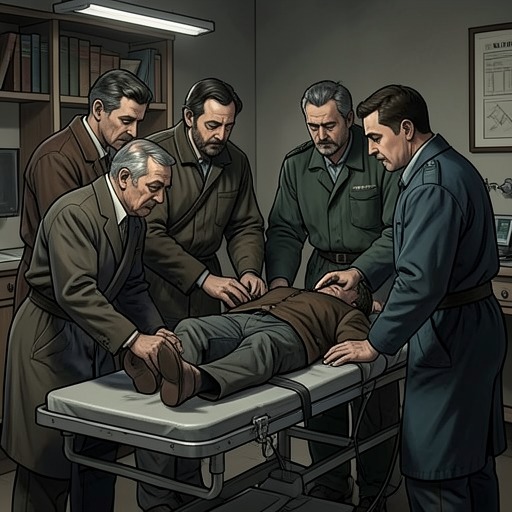
The Second Men's Decision to Choose Voluntary Euthanasia
Last and First MenThe Second Men's Decision to Choose Voluntary Euthanasia is the Second Men's collective response to a postwar epidemic that left much of the population with lasting physical damage. As ageing survivors gradually lost their ability to work, they decided that individuals judged by their generation to have outlived their competence should end their lives. The decision is presented both as an act of loyalty and as a severe sacrifice made under pressure to preserve society.
Causes and Conditions
The decision followed the defeat of the Martian invaders, whose dispersed Martian Subvital Units became a virulent infection after the invaders died. Though research eventually found a way to check it, the years of infection had already corroded the tissues of those who were stricken. Purging made the atmosphere and human bodies clean again; it could not restore the affected generations.
The consequences extended beyond individual illness. Fertility among the stricken was greatly reduced, leaving a small population of healthy people below middle age alongside a much larger population of ageing invalids. For years, the older survivors continued the work of the world despite their frailty. Gradually, however, they lost both endurance and competence, while the young had to take on work before they were equipped to do it and made mistakes their elders would have avoided. The material destruction of civilization and the resulting economic crisis made this generational imbalance an immediate social problem.
The Decision and Its Opposition
The stricken generations decided, almost unanimously, that a person should commit suicide whenever that person's generation declared that they had outlived their competence. The decision therefore rested not simply on an individual's assessment of illness, but on a collective judgment about capacity and the needs of the community.
The younger generation initially opposed the policy. Its members still loved and respected their elders, whom they regarded as wise despite their diminished vigour, and feared carrying on without them. The elders nevertheless maintained their position. Many younger people were no longer children, and, in the elders' judgment, the body politic could not survive the economic crisis without removing its damaged tissues. The conflict set affection and dependence against a stark calculation about the society's ability to continue.
Implementation and Aftermath
The policy was carried out one person at a time, as occasion demanded. The stricken chose what the narrative calls the peace of annihilation, leaving a population that was scanty and inexperienced but vigorous enough to rebuild what had been destroyed. The decision did not reverse the epidemic's damage or restore the lost generations; it transferred the burden of reconstruction to the survivors who remained.
The response is later repeated after another Martian attack, four centuries on. Once again the Martians are destroyed, and once again the Second Men face pulmonary infection, prolonged purging, a crippled population, and what the narrative describes as generous suicide. This recurrence makes the first decision part of a repeating aftermath rather than a single resolution: victory over the invaders is followed by delayed biological harm and another generational sacrifice.
Social and Narrative Significance
The episode frames the decision as an extraordinary expression of loyalty, sharply contrasting it with the recrimination that the crisis might have produced. Yet that solidarity takes a severe form: the community makes competence a threshold for continued life, and the elders' insistence turns voluntary death into an answer to economic and civic necessity. The younger generation's protest preserves the emotional cost of the policy within the same account that praises the Second Men's collective resolve.
The sequence also distinguishes the apparent end of the war from its prolonged consequences. The Martian forces have been defeated, but the survivors inherit an infection that research can contain only after lasting damage has been done. The decision emerges from that gap between military victory and bodily recovery, and its recurrence after later invasions underscores how repeatedly the Second Men are forced to rebuild from a diminished population.